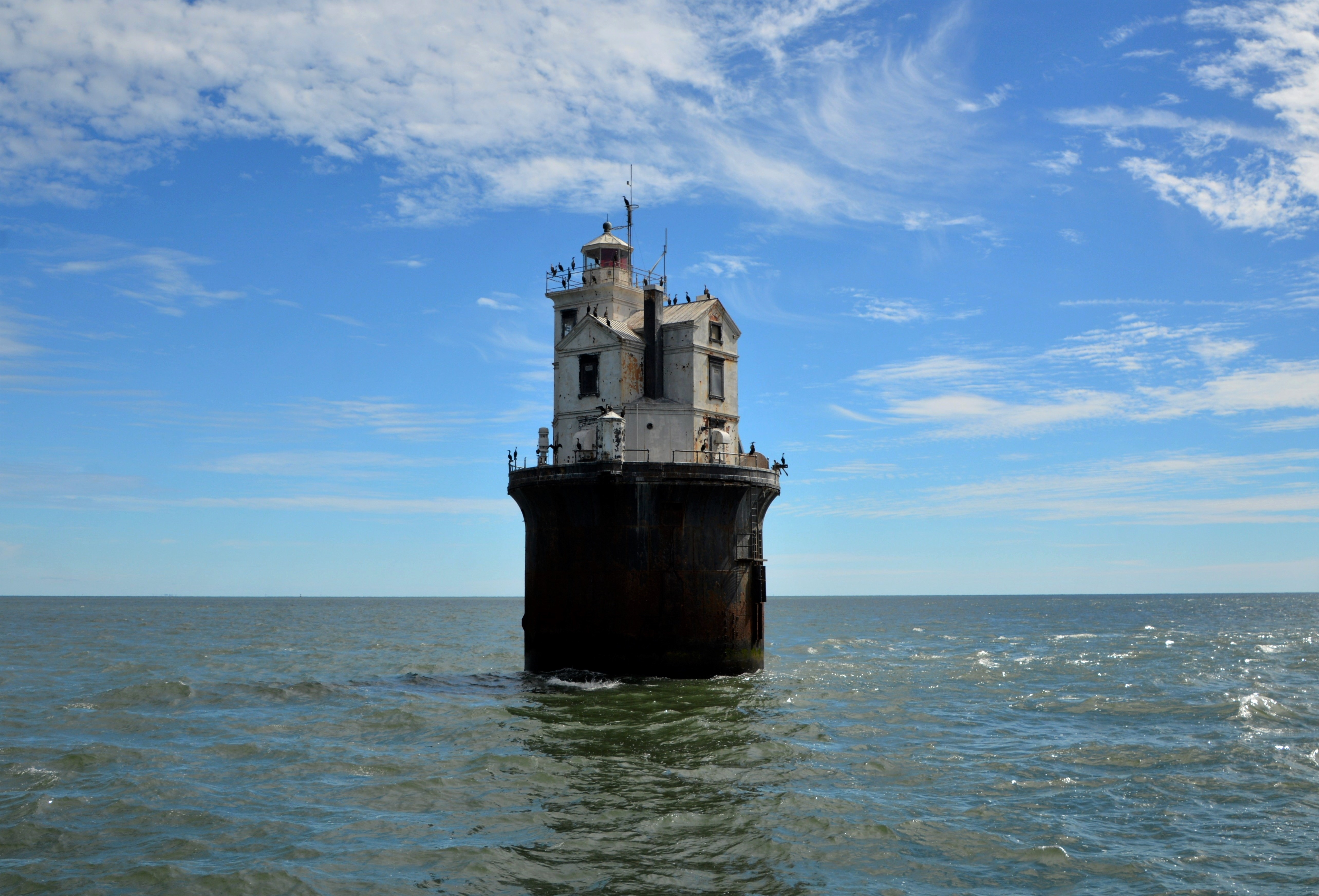
Nehemiah Maull, born in 1737, was employed as a Delaware River pilot, an occupation that he shared with his father John, who had immigrated to Lewes, Delaware from England in 1725. In 1780, Nehemiah set out on a voyage to England to stake his claim to a portion of the family fortune. Given his occupation, Nehemiah was surely acquainted with the hazards of navigating Delaware Bay, but apparently the captain of the vessel on which Nehemiah was traveling was not, as the ship wrecked on an unnamed shoal in the bay. Nehemiah perished in the accident, but in honor of his years of service on Delaware Bay, his name was given to the shoal, so that he would live on in the memory of those navigating the bay. His multi-syllabic first name must have been considered too long, as the name given the shoal was just Miah Maull. With a width of 800 yards and a length of 1,000 yards, Miah Maull Shoal lies just east of Delaware Bay’s main shipping channel. Though late in coming, a lighthouse for the shoal was finally recommended by the Lighthouse Service in 1904 at a projected cost of $75,000. Congress allocated $40,000 for the project in 1906, and the remaining $35,000 the following year. With the lighthouse fully funded, a test boring was made on the proposed site, a circular area with a diameter of 400 feet that was ceded to the federal government by the State of New Jersey. Miah Maull Lighthouse would be of the caisson style, and the pieces of the cast-iron shell for its foundation were fabricated by Lynchbourg Foundry Company of Virginia at a cost of $8,633.47 and shipped to Christiana Depot near Wilmington, Delaware in July 1908. Around that same time, a working platform was built near the shoal, and 187 fourteen-inch white-oak piles were driven into the shoal to a depth of twenty-one feet. After reaching the prescribed depth, the heads of the piles were cut off at a height of one foot above the shoal to support the lighthouse’s foundation. To protect the foundation, a four-foot-thick layer of riprap, having a diameter of 160 feet, was placed around the base of the caisson. In the meantime, Richard Mfg. Co. of Bloomberg, Pennsylvania was working on the cast-iron lighthouse superstructure, which was “in the form of a frustum of a cone, three stories high, surmounted by a watch room and fourth-order helical bar lantern, and surrounded at the base by a veranda.” A temporary light, mounted atop the completed lighthouse foundation, became operational on September 13, 1909, and this makeshift beacon would have to serve for a couple of years as funds for Miah Maull Lighthouse were depleted. Congress provided an additional $30,000 on March 4, 1911, and a contract for erecting the superstructure and completing the station was made on April 4, 1912. Work at the site began in May 1912, and over the next few months, the lighthouse was pieced together atop the foundation. A permanent light and temporary fog signal, a 2,000-pound bell struck by machinery, were established on February 15, 1913. The station’s third-class Daboll foghorn went into operation on December 5, 1913 and had two trumpets, one pointing up the bay and the other down the bay. Two, five-horsepower kerosene engines powered an air compressor, which compressed the air up to 100 pounds per square inch. The total cost of the station was $104,102. The living quarters for the keepers consisted of a kitchen and dining room on the first floor, two bedrooms and a bathroom on the second floor, and another pair of bedrooms on the third level. The original lens used in Miah Maull Lighthouse was manufactured by Barbier, Benard & Turenne of Paris in 1912 and was marked as “456 – U.S.L.H.S.” The lens completed one revolution every fifteen seconds atop steel ball bearings, and ruby glass was positioned in the lantern room to mark the shoal side of the lighthouse. One of the Macbeth-Evans lenses, a fourth-order, six-panel, fixed lens, replaced the rotating lens in Miah Maull Lighthouse. This optic remained in service for years, but was reportedly removed by the Coast Guard in 1999. The Coast Guard assumed responsibility for Miah Maull Lighthouse in 1939. The Coast Guard removed their last crew from the station in 1973, after automating the lighthouse. The metal veranda on the first level was later removed as well, having deteriorated past the point of repair. Lewis Maull, a descendant of Nehemiah Maull, was successful in having the lighthouse added to the National Register of Historic Places in 1991, and a plaque commemorating the honor was installed on the first level of the lighthouse in October of that year. With the Coast Guard from Cape May and descendants of Nehemiah Maull still interested in its future, Miah Maull Lighthouse continues to warn vessels away from the shoal as it honors one who helped others safely navigate the bay.
Located near the center of the Delaware Bay, eight miles south of Fortescue and 18.5 miles northwest of Cape May.
GPS: Latitude: 39.126647, Longitude: -75.208682


.JPG)
.JPG)