Sunday, September 13, 2015

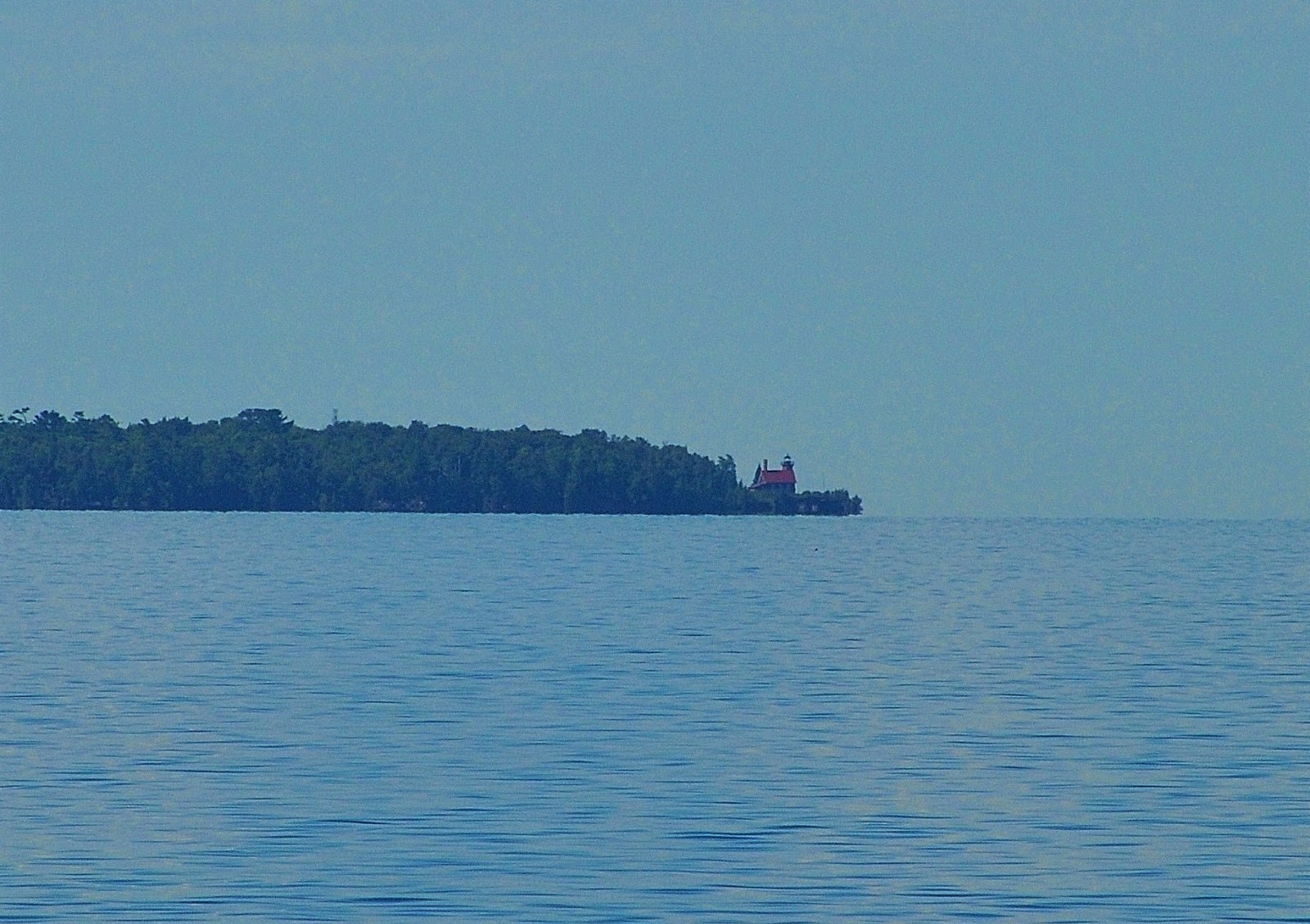
SAND ISLAND LIGHTHOUSE-SAND ISLAND, WISCONSIN


                          ( NOTE: QUALITY IS GREATLY DIMINISHED DUE TO THE APPROXIMATE 5 MILES IN DISTANCE FROM WHERE PHOTOGRAPHED)


                                                                                                                  Sand Island Lighthouse in 1913
                                                                                                                         Photograph courtesy from the U.S. Coast Guard

In 1871, the Lighthouse Board requested funds to establish lights on Outer Island and Sand Island to mark, respectively, the eastern and western end of the Apostle Islands. Lighthouses had earlier been established on Michigan Island, Long Island, and Raspberry Island to help vessels navigate through the islands, but b y this time most maritime traffic was bypassing the islands, headed for the booming port at Duluth, Minnesota.Outer Island Lighthouse was activated in 1874, and three years later the Lighthouse Board renewed its plea for a light on Sand Island: Incoming from Duluth, the Raspberry Island light is not visible until abreast of Sand Island, and there being no coast light in this distance of 80 miles, causes much distress and danger to the increasing commerce of the west end of Lake Superior. An appropriation of $18,000 for the building of this station is recommended. " Congress finally funded the lighthouse in 1880, and work on the island commenced on June 6, 1881, under the supervision of Louis Charles Lederle. The plans for the lighthouse, a Norman Gothic design consisting of a tower rising from one corner of a one-and-a-half-story keeper’s dwelling, had been used elsewhere in the Great Lakes - Chambers Island and Eagle Bluff (1868), McGulpin’s Point (1869), Eagle Harbor and St. Clair Flats Canal (1871), and White River (1875) - but this would been the first time that sandstone was used rather than brick.  On July 2, 1881, the Bayfield County Press noted the ongoing work on Sand Island. Sand Island. Supt. Lederle has cleared about ten acres of ground and opened a fine quarry of red sandstone which will be used for the government buildings. The Light House proper will be thirty-eight by twenty-eight feet in size, and the light will be places about fifty feet above the water level. No structure could have a more profound connection to its environment than the exquisite little lighthouse on Sand Island, constructed from the same stone as the promontory on which it sits. It is as if the builders simply reshaped the fabric of the island into lighthouse form. The dwelling’s gables feature gingerbread ornaments, and the tower transforms from a square in its lower half to an octagon in its upper half. A fourth-order, Henry-Lepaute Fresnel lens was installed atop the forty-two-foot tower and commenced showing a fixed white light on September 25, 1881. On April 23, 1921, an acetylene gas apparatus started emitting a white flash every ten seconds from the lantern room, and Sand Island became the first lighthouse in the Apostle Islands to be automated. Keepers at Raspberry Island subsequently kept an eye on the light. A forty-eight-foot, steel, skeletal tower was erected near Sand Island Lighthouse in 1933, and the light was transferred to it. The Coast Guard removed the steel tower in 1985 and returned the light to the lighthouse’s lantern room.

ASHLAND BREAKWATER LIGHTHOUSE-ASHLAND, WISCONSIN


Situated on the southern side of Chequamegon Bay, the City of Ashland was incorporated in 1887. Several docks and piers were built along the shore at Ashland to support the export of brownstone, lumber, and iron ore, an important part of the city's economy. Between 1889 and 1893, a mile-and-a-half-long breakwater was constructed northeast of the harbor at Ashland to protect it from northeast storms. To strengthen the breakwater, built of piles capped with a concrete slab, riprap was placed along its length between 1903 and 1909 to form a rubble mound breakwater. A fixed lens lantern was established on a new pierhead crib off the western end of the breakwater on July 1, 1911. Three hundred and fifty tons of rock were placed atop the pierhead to hasten its settling, and by the spring of 1913, it had settled 3.16 feet, with only 0.01 foot of settling in the last six months. With the pierhead having reached a fixed position, the rocks were removed, and a concrete cap was poured on top of it. After Congress appropriated $25,000 on October 22, 1913, construction commenced on a reinforced concrete lighthouse atop the pierhead in 1914 and continued until weather conditions forced the work to be stopped for the winter. Work resumed the following year, and the tower’s fourth-order, Sautter, Lemonier & Cie Fresnel lens was placed in operation on October 15, 1915. The Lighthouse Service gave the following description of the lighthouse: The tower is hexagonal in plan and pyramidal in shape with a cylindrical watch room.The materials of walls are of reinforced concrete throughout except the watch room which is steel. The first story of the tower has vertical walls, the pyramidal section starting at the second floor level. In plan the base of tower is 21 feet overall, tapering to extreme dimensions of 13 feet 6 inches at the base of the watch room. The cylindrical watch room is surmounted by a fourth-order helical bar lantern with a focal plane 55 feet above the top of the pier. the outside walls are left natural concrete finish. Provision has been made in the base of the tower so that the entire superstructure can be releveled, should this ever become necessary, by means of hydraulic jacks. Living quarters are provided in the second and third stories of the tower, to be occupied in case of necessity. The pier is provided with a derrick for handling the keeper's launch. Commercial power was run to a control station at the boat house to where it was transformed from 2200 volts to 220 volts and 110 volts. An armored submarine cable led from the control station to the eastern end of the breakwater and then followed the breakwater to the lighthouse. A common sign flasher in the control station produced the light's flashing characteristic of two seconds of light followed by a one second eclipse. An electric siren fog signal was located in the tower's watch room, from where a galvanized sheet metal trumpet protruded to concentrate the sound. The fog signal produced a four second blast in every twenty seconds. The total cost for the lighthouse came to $24, 944. The light was automated in 1962, and the Fresnel lens was removed from the lantern room and replaced by a modern optic in 1980. In 2014, a measure in the 2015 National Defense Authorization Act transferred Ashland breakwater Lighthouse to the National Park Service. The breakwater lighthouse thus became the ninth lighthouse included in the Apostle Islands National Lakeshore.


ONTONAGON WEST PIERHEAD LIGHTHOUSE-ONTONAGON, MICHIGAN


ONTONAGON LIGHTHOUSE-ONTONAGON, MICHIGAN


Congress appropriated $5,000 for Ontonagon Lighthouse on September 28, 1850, and W.F. Chittenden, a Detroit contractor, was hired to build it on a 22.63-acre parcel on the west side of the entrance to the Ontonagon River that had been acquired in April 1847. The original Ontonagon Lighthouse consisted of a one-and-a-half-story stone dwelling, measuring thirty-eight by twenty feet, which was topped by a short tower. An array of six lamps set in fourteen-inch reflectors was used to produce a fixed white light at a height of thirty-five feet above the lake, until a fifth-order Fresnel lens was installed in the tower in 1857. Samuel Peck was appointed the light’s first keeper on August 26, 1853. Like all the other early lighthouses built on Lake Superior, the first Ontonagon Lighthouse had a short life. Congress appropriated $14,000 on April 7, 1866 for “repairs and renovations at Ontonagon light-station,” but during that year an entirely new “schoolhouse” style lighthouse was built, consisting of a nine-foot-square tower centered in the lake-facing gable of a one-and-a-half-story brick dwelling. The fifth-order Fresnel lens from the original lighthouse was transferred to the new decagonal lantern room, where it was mounted atop a cast-iron pedestal. The 1888 Annual Report of the Lighthouse Board noted the following improvements to the station: “A frame wood shed, 12 feet by 20 feet in plan, was built near the dwelling. A brick cistern, with a capacity of 338 gallons, to supply water for domestic purposes, was built in the rear of the dwelling. A wagon road was made from the station to the nearest public road, and materials were furnished for the construction of a root-house.” Two years later, an eighteen-foot-square kitchen was attached to the rear of the dwelling. A brick oil house, with a capacity of 360 gallons, was built in 1902, and the water pipe connecting the dwelling to a pump was lowered twenty inches that same year to prevent it from freezing. In 1904, dormers were added to the lighthouse to provide light and additional space in the upper story. Arnold Huuki, the last of the nine keepers of Ontonagon Lighthouse, retired on January 1, 1964, when the light was discontinued. Just over a month earlier, Keeper Huuki had been presented a diamond pin for forty years of efficient and faithful government service. Arnold and Lillian Huuki continued to live in the lighthouse after it was discontinued, but the property was eventually turned over to the U.S. Army Corps of Engineers, who were dredging the river. For a number of years, the lighthouse served as a clubhouse for the local coast guard auxiliary.

Saturday, September 12, 2015

BIG BAY POINT LIGHTHOUSE-BIG BAY, MICHIGAN


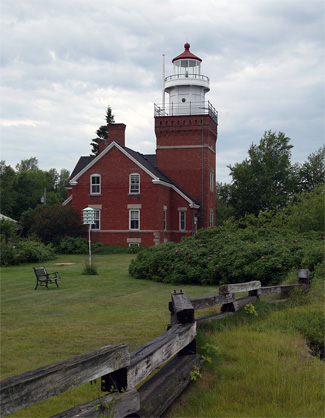
Big Bay Point lighthouse stands on a rocky point halfway between Marquette and Keweenaw Portage Entry. The establishment of a lighthouse at Big Bay Point was recommended by the Lighthouse Board in 1892, as coasting steamers had to change course at the point and there was protected anchorage on either side of the point : Big Bay Point occupies a position midway between Granite Island and Huron Islands, the distance in each case being 15-18 miles. These two lights are invisible from each other and the intervening stretch is unlighted. A light and fog signal would be a protection to steamers passing between these points. They include all the Lake Superior passenger steamers running between Duluth, Buffalo, and Chicago which carry freight and stop between all the important points on the south side of Lake Superior, including Marquette and the copper ports on Portage Lake. Quite a number of vessels have in past years been wrecked on Big Bay Point. A light and fog signal station at Big Bay Point was authorized by an act of Congress on February 15, 1893, and $25,000 for its construction was appropriated on August 18, 1894. After a roughly five acre parcel was acquired in 1895, construction of the station began in May 1896 and was completed the following October. The first structures built at the site were a landing crib and a barn. The crew and supplies were housed in the barn, which had an inside privy in one corner with an outside clean out. The lighthouse was built as a two-story, eighteen-room, redbrick duplex dwelling, with a sixteen-foot-square tower centered on its lakeward side. The tower and lantern room stood nearly sixty-four feet tall, but thanks to the lofty bluffs at the point, the light had a focal plane of eighty-nine feet. In addition to the lighthouse, the station featured two small brick privies, a brick oil house with a metal roof, and a twenty-by-five- foot redbrick fog signal building, which was built a few hundred feet north of the lighthouse. On October 20, 1896, the third-order fixed Fresnel lens, manufactured in France by Henry-Lepaute, went into service. The lens was “fitted with a 3 wick burner same as a 2nd order light and consuming the same quantity of oil.” Four flash panels, fitted in a cost-iron frame, revolved around the lens to produce a brilliant flash every twenty seconds. The weights for revolving the flash panels were housed in a drop tube that ran from the service room down into the basement and had to be wound up every five hours. The station’s fog signal, which also commenced operation on October 20, 1896, was a ten-inch steam whistle, whose water came from a twenty-foot-square crib sunk in Lake Superior. In 1928, a type “F” diaphone, powered by oil-engine-driven air compressors, replaced the obsolete steam whistles. In 1911, additional land surrounding the lighthouse was purchased and cleared to increase the light’s arc of visibility and to provide a more suitable site for a landing and tramway. The lighthouse was manned by a number of keepers over the next forty-three years. In the mid-forties, under the authority of the Coast Guard, the last keeper was reassigned, and the light automated. 

MARQUETTE HARBOR LIGHTHOUSE-MARQUETTE, MICHIGAN


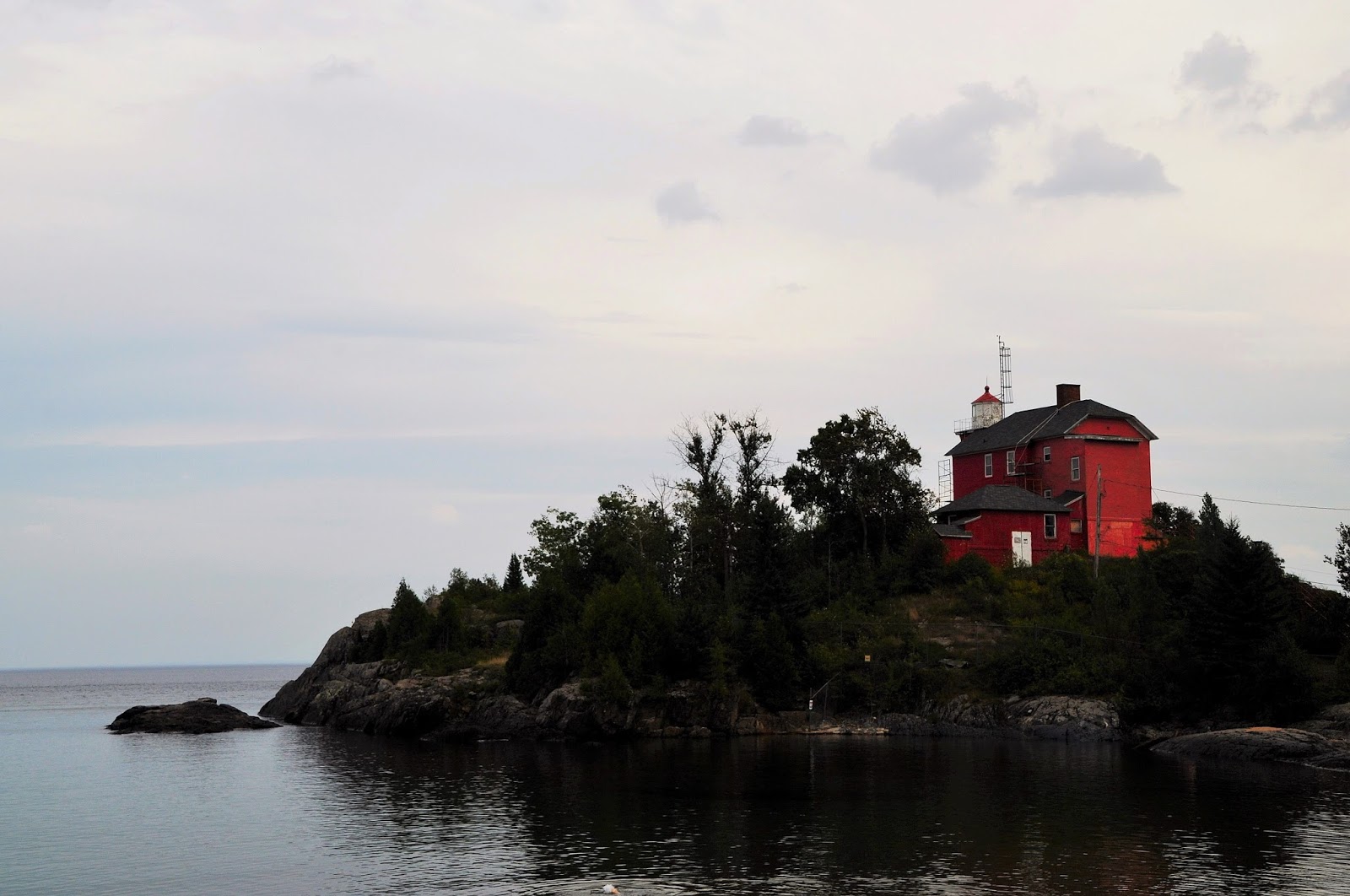
The early importance of the harbor at Marquette is evidenced by the fact that it was marked by one of just a handful of lighthouses built on Lake Superior before the opening of the Soo Locks in 1855. Congress provided $5,000 for the lighthouse on September 28, 1850, and all but $25 of this sum was spent in its construction. The first lighthouse at Marquette was established on the point just north of the harbor in 1853 and consisted of a stone tower that stood twenty-six feet, eight inches tall and tapered from a diameter of ten feet, six inches at its base to six feet, five inches at its octagonal lantern room. A sixth-order Fresnel lens was being used in 1858 to produce a fixed white light, and a one-and-a-half-story stone dwelling was located nearby for the keeper. The stone tower and dwelling didn’t stand up well to the extreme weather of the Upper Peninsula, and in 1865 the Lighthouse Board submitted an estimate for “extensive repairs and renovations.” Congress provided $13,000 on April 7, 1866 for “repairs and renovations,” but during the following months a completely new lighthouse was constructed on the point. This second incarnation was built of yellow brick and consisted of a dwelling with a square tower centered in its lakeward-facing gable end. In 1870, a fourth-order Fresnel lens that illuminated an arc of 270° replaced the previous lens, which had an arc of just 180°. A ten-inch steam whistle was added to the station in 1874, and six years later it was joined by a duplicate whistle for increased reliability. The fog signal buildings were placed at a lower elevation nearer the lake and were linked to the dwelling by an elevated walkway. The number of hours the coal-fired steam whistle was in operation each year varied greatly. In 1887, the station’s whistle blew for a record 697 hours, or about eight percent of the time, while in 1904, it sounded for just 189 hours, or just two percent of the time. On average, the steam whistle was in operation 325 hours a year and consumed around twenty tons of coal. Work on a new brick fog signal building on the point commenced in 1911 and was completed the following year when a compressed-air siren was installed to replace the old steam fog whistles. The air compressors were changed from oil driven to electrically driven in 1922, and in 1941, a two-tone air diaphone took the place of the air siren. A radiobeacon was added to the station in 1928 as an additional aid for mariners navigating during thick weather. A new fourth-order Barbier, Benard, and Turenne Fresnel lens, which was equipped with four flash panels and produced a red flash every five seconds, replaced the station’s fixed lens in 1908. The following year, the illuminant used in the light’s lamp was changed from oil to incandescent oil vapor. The light source was changed to electricity in 1921. As the keepers of Marquette Lighthouse were also responsible for the light and fog signal on the nearby breakwater, the position of second keeper was added to the station in 1910. To provide more living space, a work crew arrived in 1910 and converted the old brick lighthouse into a duplex by increasing the height of its walls to create a full second story. The lighthouse received its now familiar red daymark in 1911 and an addition to its shoreward side in the 1950s.

SEUL CHOIX POINT LIGHTHOUSE-MICHIGAN


                                                                                                          Seul Choix Point Lighthouse in 1913
                                                                                                       Photograph courtesy National Archives
In its annual report for 1885, the Lighthouse Board noted the following: “During the prevalence of northwest winds, this coast is followed by many vessels from Chicago and Milwaukee, and Seul Choix offers a good harbor of refuge in these winds, with good anchorage in from 3 ½ to 4 fathoms of water. There is no light on this northern shore between Poverty Island and Saint Helena [lighthouses], a distance of about 100 miles.” Due to the increase of the iron-ore trade at Escanaba, the route along the northern shore of Lake Michigan was becoming more important, and the Lighthouse Board requested $15,000 for a lighthouse to mark Seul Choix Point. Congress appropriated the necessary funds on August 4, 1886, and a site for the station was selected later that month.   

Pursuant to authority granted, the materials were procured and operations at the site were begun August 31. Work was continued until November 16 under very disadvantageous circumstances, the fall weather being exceptionally stormy and severe, involving much loss of time and interruption and delay to the work. Seeing that it would be impracticable to complete the station in time to have it in service by the spring of 1892, I recommended and the Board approved the construction of a temporary tower for the station light, which, in connection with the nearly completed dwelling and other necessary appurtenances, would enable the station to be put in commission. This has been done, but it was found impracticable to complete the permanent tower, which now stands 20 feet high
   A temporary fourth-order light was placed in service on April 15, 1892, and the Lighthouse Board requested $3,500 to finish the lighthouse. On August 18, 1894, Congress approved the use of $5,000 set aside for moving range lights on St. Marys River for completing Seul Choix Lighthouse. At the same time, $5,500 was made available for adding a fog signal to the station. Material for finishing the lighthouse and building the fog signal building were delivered to the point by the lighthouse tenderAmaranth in the spring of 1895, and by the first of July, the oil house was completed, the boat house was nearly finished, the dwelling was replastered, the tower was raised to a height of fifty-six feet four inches, and the fog signal building was enclosed. Seul Choix’s handsome lighthouse, consisting of a stone foundation, brick tower, and metal lantern room, measures seventy-eight feet nine inches from base to ventilator ball, and its third-order Henry-Lepaute Fresnel lens was placed in operation on August 15, 1895. The station’s one-and-a-half story dwelling is attached to the tower by a covered brick passageway. The ten-inch steam whistle was placed in service on September 10, 1895 using water pumped from Lake Michigan. On November 6, 1925, the station’s fog signal was changed from steam to air diaphone, and electric lighting was provided. The last keepers left in 1972, when the station was automated following the removal of the third-order Fresnel lens.

POINT IROQUOIS LIGHTHOUSE-MICHIGAN


In January 1853, the Michigan Legislature passed a resolution requesting its senators and representatives to Congress use their influence to promote the establishment of thirteen new lighthouses in the state, including one at Point Iroquois and one on the island just off Point aux Chens, two miles east of Point Iroquois. Two months later, Congress appropriated $5,000 for a lighthouse at “Point Iroqouis, or on the island off Point aux Chens, Michigan, as the Light-House Board shall determine.” The  Lighthouse Board selected Point Iroquois as the site, and a contract was signed in 1854. Work on the lighthouse, which consisted of a cylindrical, forty-five-foot, stone tower, fitted with wood stairs and an octagonal, iron lantern room, was carried out in 1855, and Charles Caldwell, who had previously served as an assistant at Whitefish Point, was appointed the first keeper of the light in 1856. A sixth-order Fresnel lens was used in the lighthouse to produce a fixed white light that had a focal plane of sixty-five feet above the lake. A detached, one-and-half-story, stone dwelling, measuring twenty-eight feet square, was built for the keeper. The establishment of Point Iroquois Lighthouse occurred roughly one year after the opening of the Soo Locks, which led to a significant increase in vessel traffic on Lake Superior. In 1867, the Lighthouse Board requested a new iron lantern deck for the lighthouse to replace the existing wooden one. This work may not have been carried out, as two years later, the Board noted that the tower and dwelling were in such poor condition that only temporary repairs would be made and requested $18,000 for a new lighthouse. Congress quickly complied, allocating the requested amount on July 15, 1870, and work on a new lighthouse and dwelling began that same year. The second tower stands nearly sixty-two feet tall and tapers from a diameter of sixteen feet at its base to ten feet at the lantern room. A circular iron stairway winds up the brick tower and provides access to the decagonal lantern room, where a fourth-order, L. Sautter & Cie. Fresnel lens was mounted atop a pedestal. Equipped with ten flash panels, the lens revolved once every five minutes to produce white flashes spaced by thirty seconds. An eight-room, brick keeper’s dwelling was attached to the base of the tower by a covered passageway. A fog bell, struck a single blow every twelve seconds, was established at Point Iroquois on October 25, 1884 to help mariners navigate in thick weather. In 1888, the Lighthouse Board requested $5,500 for a steam fog whistle to serve “the immense number of vessels which concentrate” near the point. The necessary funds were provided in an act passed March 2, 1889, and the boilers and machinery were installed in a frame building, twenty-two by forty feet in plan, that was located 400 feet northeast of the lighthouse. First placed in operation on October 31, 1890, the ten-inch steam whistle emitted a five-second blast every thirty seconds. A well provided water for the fog signal, which was in operation about 400 hours per year while consuming roughly twenty tons of coal. In 1896, the old bell tower was taken down and relocated to the station at Grand Marais, Michigan. A forty-foot-tall brick chimney replaced the fog signal’s sheet-iron smokestacks in 1900. On May 3, 1913, the intensity of the Point Iroquois Light was increased nearly eight fold my changing its illuminant from oil to incandescent oil vapor. The period of the flashes was reduced in 1913 and then again in 1922, when the characteristic became a flash every four seconds. The fog signal at Point Iroquois was changed from a steam whistle to an air siren on April 13, 1927, and then to a type “B” air diaphone, powered by electrically operated compressors in 1933. Electricity, provided by electric generators, was also extended to the tower and dwelling in 1933. After the establishment of the offshore Gros Cap Point Light by Canada in 1962, Point Iroquois Lighthouse was deactivated in 1963. The fourth-order Fresnel lens was removed and shipped to the Smithsonian Institution in Washington D.C., and the lighthouse was declared excess property by the Coast Guard. The U.S. Forest Service applied for the lighthouse reservation in 1964 and was awarded the property in 1965.

Sunday, August 2, 2015

ERIE LAND LIGHTHOUSE-ERIE, PENNSYLVANIA


                                                                                             Erie Land Lighthouse in 1885
                                                                                    Photograph courtesy National Archives


Though Congress provided money for construction of the lighthouse in 1810 and 1811, the work was delayed by the outbreak of the War of 1812. A new allocation of $17,000 was made on March 3, 1817 for the construction of two lighthouses on Lake Erie, and Presque Isle Lighthouse and Buffalo Lighthouse were completed and commenced operation in 1818. These lights are considered the first American lighthouses built on the Great Lakes. The contract for the lighthouse called for a twenty-foot stone tower with a diameter of 9½ feet at its abase and 7½ feet at its top. Surmounting the tower was a nine-foot-tall iron lantern sheltering an array of ten lamps and reflectors. Thanks to the height of the bluff on which it stood, the lighthouse had a focal plane of ninety-three feet. Nearby, a one-story frame dwelling comprising three rooms was provided for the keeper. An inspection in 1851 found that the 1818 stone tower was starting to settle. Metal bands were placed around the tower to stabilize it, but by 1857 it was evident that the tower would have to be replaced. With a height of fifty-six feet, the replacement tower was more than twice as tall as its diminutive predecessor. A third-order Fresnel lens, called “a splendid affair” by the local paper, was installed in the tower’s lantern room. Powered by just a single lamp, this lens produced a fixed white light that was visible from a distance of thirteen miles. A new one-and-a-half-story brick dwelling with five rooms was also completed in 1858. After less than a decade of service, the new lighthouse was suffering from the same problem that had caused the demise of the first tower — a settling foundation — and frost had also contributed to cracks in its walls. The brick lighthouse was dismantled in 1866, and test borings made shortly thereafter revealed a layer of quicksand in the underlying soil that was the cause of the settling. When work commenced on a third lighthouse, plenty of attention was given to providing a proper foundation. The selected site, farther removed from the bluff’s edge, was excavated to a depth of twenty feet and then filled with eight layers of solid oak twelve-inch-square timbers. Atop the timers was placed six feet of crushed limestone set in Portland cement and several courses of stone also set in cement. Upon this massive foundation, a forty-nine-foot tower with a diameter of nineteen feet at its base and fourteen feet at its top was constructed using Berea sandstone. The basal diameter was more than twice that of the previous towers and helped to distribute the weight of the tower over a larger area. Six windows were incorporated into the tower: one at the base, one at the first landing, one at the second landing, and three with a semi-circular arch and keystone just below the gallery. Attached to the southern side of the tower is the oil room. The year of completion, 1867, is inscribed in decorative stonework above the lighthouse door. A third-order Fresnel, which produced a fixed white light, was used in the lantern room. After a new lighthouse was completed on the lake side of Presque Isle Peninsula in 1873, it took on the name of Presque Isle Lighthouse, and the old lighthouse on the bluff overlooking the harbor was renamed Erie Lighthouse, though locals referred to it as the Erie Land Lighthouse. Presque Isle Lighthouse reduced the usefulness of the bluff-top lighthouse, and in 1880 the Lighthouse Board decided Erie Lighthouse could be discontinued. The tower, minus its lantern, illuminating apparatus and iron stairs, which were removed and placed in storage at the lighthouse depot in Buffalo, was sold at public auction on March 1, 1881 along with the dwelling for $1,800 to Myron Sanford, owner of the surrounding land. Local citizens and mariners, who had long relied on the lighthouse, protested the decision, and on July 7, 1884, Congress provided $7,000 to re-establish the light. The property was promptly repurchased, and a custodian was paid to watch the site, which was “endangered by tramps,” until the lighthouse could be reactivated. Most of the metalwork was still in storage in Buffalo, but some pieces were missing or broken and had to be replaced. This unexpected work delayed the reactivation of the light until July 1, 1885, when the light from a new revolving third-order Fresnel was exhibited from the tower. In 1894, a supply of natural gas was piped from a nearby well to the keeper's dwelling, where it was used for fuel. George W. Miller was made the first keeper of the new light, transferring to Erie after sixteen years at Conneaut Lighthouse. Keeper Miller would serve until 1899, when the Erie Land Lighthouse lost its keepers for good. The lantern room was removed from the tower and transferred to Marblehead Lighthouse in Ohio, where it is still in use today.